


How to make charcoal briquettes from agricultural waste?

Editor: Henan Doing
Date:August 17, 2026

Every harvest season leaves behind a large amount of agricultural waste, like rice husks, corn cobs, straw, coconut shells, sawdust, and many other residues. In the past, these materials were often burned openly or simply discarded. Today, more and more producers are discovering that agricultural waste can be transformed into valuable charcoal briquettes, creating a new income stream while reducing environmental pressure.
Agricultural waste is especially suitable for briquette production because it is widely available, renewable, and easy to process when handled correctly. Producing charcoal briquettes from agricultural waste typically involves four core steps: crushing, drying, carbonization, and molding.
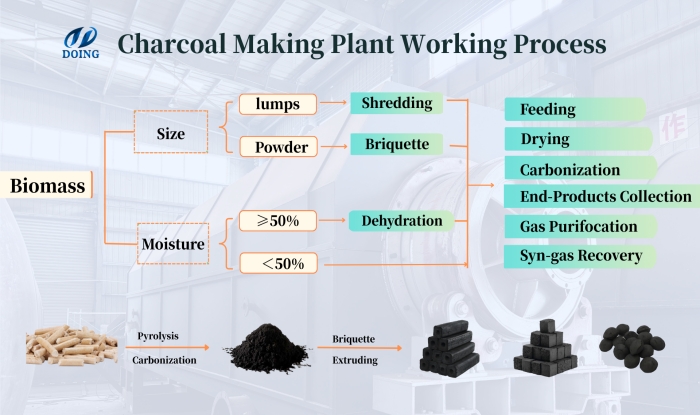 Making charcoal briquettes from agricultural waste process
Step One: Crushing and Drying of Raw Materials
Agricultural wastes vary significantly in size and moisture content. To ensure the stability of the subsequent carbonization process, large-sized raw materials (such as tree branches and long stalks) must first be crushed to an appropriate size. Subsequently, the moisture content of the raw material is reduced to the desired range (typically below 15%) using drying machine.
Step Two: Carbonization of Agricultural Waste
This is the most critical step in the entire process. The prepared agricultural waste is fed into carbonization furnace. Under high-temperature, oxygen-limited environment, the raw material undergoes pyrolysis; volatile components are released while carbon is retained and converted into carbon powder.
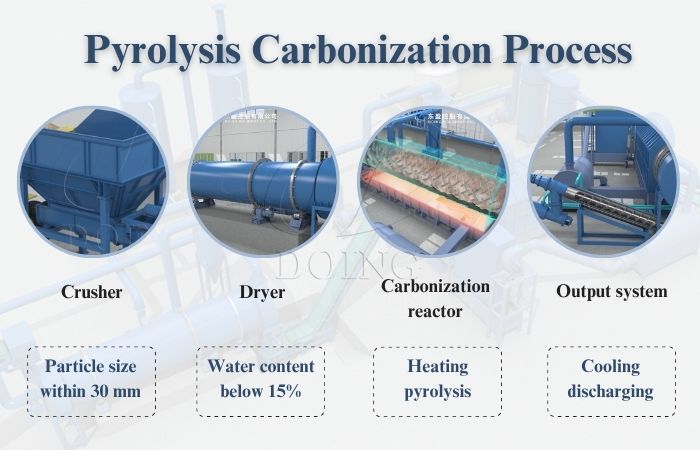 Pyrolysis carbonization process for agricultural waste
Step Three: Briquetting and Shaping
To make charcoal briquettes from the charcoal powder obtained through carbonization, the powder must be thoroughly mixed with an appropriate amount of eco-friendly binder and water before being fed into the briquetting machine. The charcoal briquetting machine then uses mechanical compression to press the mixture into charcoal briquettes of various shapes and specifications.
Different molds can be selected based on market demand to produce machine-made charcoal in various shapes, such as blocks, rods, or spheres.
Step Four: Drying and Packaging
Charcoal briquettes formed through physical compression contain a certain amount of moisture and must be dried before use or sale. Proper drying improves ignition, reduces smoke, and extends storage life. Once the moisture content meets the required standards, the charcoal briquettes can be packaged and sold for applications such as the barbecue market, industrial heating, or residential heating.
After understanding how to make charcoal briquettes from agricultural waste, selecting a stable production line is key to the project's success. With years of experience in biomass carbonization technology, Henan DOING Company is dedicated to helping global clients build efficient, clean, and profitable charcoal briquette production lines:
①We design biomass carbonization machine specifically for processing agricultural waste. Our system accommodates a wide range of raw materials, including agricultural and forestry waste, while ensuring stable operation and uniform carbon quality.
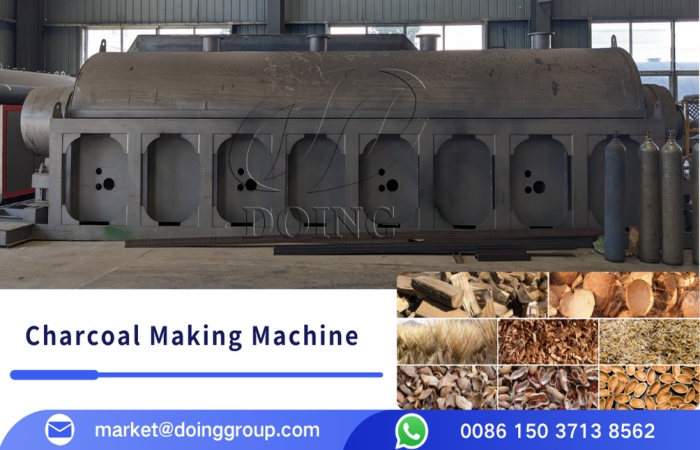 Agricultural waste biomass carbonization machine
②We also offer reliable charcoal briquetting machines designed for continuous and stable production, suitable for agricultural waste-based charcoal briquettes.
Turning agricultural waste into charcoal briquettes is both an environmental solution and a practical business opportunity. While the process itself is straightforward, long-term success depends on reliable equipment, proper system design, and professional technical support.
If you plan to start a charcoal briquette production project using agricultural waste, please contact DOING Company; we are ready to provide you with practical solutions and reliable equipment support.
FAQ: Making Charcoal from Agricultural Waste
Q: What types of agricultural waste are suitable for carbonization?
Almost all biomass residues with high carbon and woody content can be carbonized. Common and highly suitable materials include rice husks, corn cobs, crop straw, coconut shells, sawdust, wood branches, peanut shells, and palm waste.
Q: What is the temperature range for carbonizing agricultural waste?
The carbonization process typically takes place within a high-temperature range of 300°C to 600°C. The exact temperature can be adjusted depending on the density of the raw materials and the desired fixed carbon content of the final charcoal powder.
Q: What specifications of carbonization machines does DOING Company provide?
DOING Company provides diverse agricultural waste carbonization machine configurations to meet different project scales. All equipment can be customized to match your specific capacity needs.
| ①Batch Type Carbonization Machine | ||||||||||
| Model | DY-0.1 | DY-0.5 | DY-1 | DY-2 | DY-5 | DY-10 | DY-12 | DY-15 | ||
| Capacity | 100KG | 500KG | 1T/D | 2T/D | 5T/D | 10T/D | 12T/D | 15T/D | ||
| Price | $28000+ - $92000+ | |||||||||
| ②Semi-Continuous Type Carbonization Machine | ||||||||||
| Model | DY-S-5 | DY-S-10 | DY-S-12 | DY-S-15 | ||||||
| Capacity | 5T/D | 10T/D | 12T/D | 15T/D | ||||||
| Price | $82000 - $152000+ | |||||||||
| ③Fully-continuous Type Carbonization Machine | ||||||||||
| Model | DY-T-1 | DY-T-3 | DY-T-5 | |||||||
| Capacity | 1T/H | 3T/H | 5T/H | |||||||
| Price | $100000+ - $580000+ | |||||||||
| Note: The prices below are for reference only; please contact DOING Group to obtain the latest carbonization machine solutions and detailed equipment configuration price list. | ||||||||||
Q: What are the unique advantages of DOING's agricultural waste carbonization equipment?
①Precise Process Segmentation: The inner cylinder specializes in low-temperature drying/ pre-pyrolysis, while the outer cylinder handles carbonization. This design promotes macromolecular polycondensation, maintains the uniform furnace temperature, and results in a higher carbon yield with consistent, uniform quality.
②Uniform Heating & Stable Quality: The counter-rotating dual-cylinder system, combined with lifting flights, continuously tumbles and drops the material. This eliminates localized overheating or incomplete carbonization, ensuring the finished charcoal in each batch has a consistently high fixed-carbon content and low ash content.
③Gradient Fractional Condensation: Tar and wood vinegar are collected separately to prevent them from mixing and forming sticky agglomerates. This drastically reduces the risk of clogging in the heat exchange tubes. The high purity of these by-products facilitates downstream deep processing and boosts their economic value.
④Exceptional Thermal Efficiency: The built-in pyrolysis gas recovery and combustion system purifies the generated combustible gases and recirculates them to heat the furnace. This significantly cuts down on external fuel consumption, achieving an energy-saving, self-sustaining heating operation.
⑤Dual Environmental Benefits: Operating in a fully enclosed system with flue gas purification and circulation, the process reduces its own carbon emissions while achieving the goal of minimizing agricultural waste, aligning with international environmental standards and policy directives.
Furthermore, our equipment holds authoritative CE and ISO certifications, ensuring durable, safe, and environmentally compliant operations that meet international export standards.
Leave Message
Please kindly leave your requirements in detail, or contact us via +86 15037138562. Our professional sales manager will contact you within 24 hours. Your contact information will be protected.
- QWhat machine do you want to learn about?
- Solar Panel Recycling Machine
- Lithium Battery Recycling Machine
- E-waste PCB Recycling Machine
- Copper Wire Recycling Machine
- Carbonization Pyrolysis Machine
- Radiator Recycling Machine
- Aluminum Plastic Recycling Machine
- Other:
- QWhat raw material do you want to process?
- Bamboo
- Wood
- Sawdust
- Coconut shell
- Palm Kernel Shell
- Wood Chips
- Not decided yet
- Other:
- QMachine processing capacity (tons of feedstock)
- Other:
- Not decided yet
- QWhat final product do you mainly want to obtain? For what applications?
Copyright © 2015-2026 DOING Holdings - Henan Doing Environmental Protection Technology Co., Ltd | Privacy Policy | All Rights Reserved